%20300.png)
UMASS Landscape Update

Gladiolus in peak flower. Photo by Nicholas Brazee
Pioneer Valley (Amherst)
General Conditions:
After a brutal stretch of heat and humidity in early July, temperatures have moderated nicely as we round into the final week of the month. We did experience a few days of high heat and humidity this past reporting period (July 14 – July 15) but the dominant theme was the emergence of surface haze from Canadian wildfire smoke that blanketed much of northeast and mid-Atlantic.
Scattered storms on July 18 (0.3–0.6”) and July 21 (0.3–1.0”) produced varied accumulations across the tri-counties. Don’t be fooled by the appearance of wet soil after these types of storms, always hand check to determine if sufficient wetting occurred. Watering after minor (e.g. 0.25”) rain events can be more efficient since the upper organic layer is already wetted, reducing the amount of water required. Overall, the landscape appears healthy with only scattered pockets of stressed and weakened trees and shrubs. Let’s hope for some soaking rain in August, as we all remember the late summer drought of 2024 and the stress that wrought on plants entering winter dormancy.
There’s an abundance of mid-summer color right now from coneflowers (Echinacea), Hosta, daylilies (Hemerocallis), Russian sage (Salvia yangii), Crocosmia, mountain mint (Pycnanthemum muticum), butterfly weed (Asclepias tuberosa), garden phlox (Phlox paniculata), and blackeyed Susan (Rudbeckia).
Late summer is a good time to identify mature, overstory trees and shrubs that may be encroaching over gardens, taking up valuable sunlight as the sun angle changes. However, pruning to “push back the edges” is often best accomplished in the winter.
Pests/Problems:
It’s still too early to say for certain, but it may be a big year for giant tar spot (Rhytisma acerinum) on Norway maple (Acer platanoides). The first symptoms of the disease are small, circular, yellow-colored spots that are scattered across the surface of the foliage. Over time, the centers become black as the spots expand and coalesce. Significant leaf shedding can occur as result of the disease, typically in mid-August. Outbreaks occur roughly once every decade (Sinclair and Lyon 2006), with the last major outbreak of giant tar spot taking place in 2017. While much maligned, Norway maples comprise a significant percentage of mature canopy throughout urban forests in Massachusetts, and we have no choice but to promote their health.
Tubakia leaf blotch (Tubakia spp.) symptoms on oak (Quercus) are easy to find across the UMass campus on various species.
Annual mushrooms of wood-rotting fungi are starting to appear across the Pioneer Valley and state. Fruiting bodies of Ganoderma sessile (Reishi), Bondarzewia berkeleyi (Berkeley’s polypore), and Laetiporus (chicken of the wood) have been observed recently.
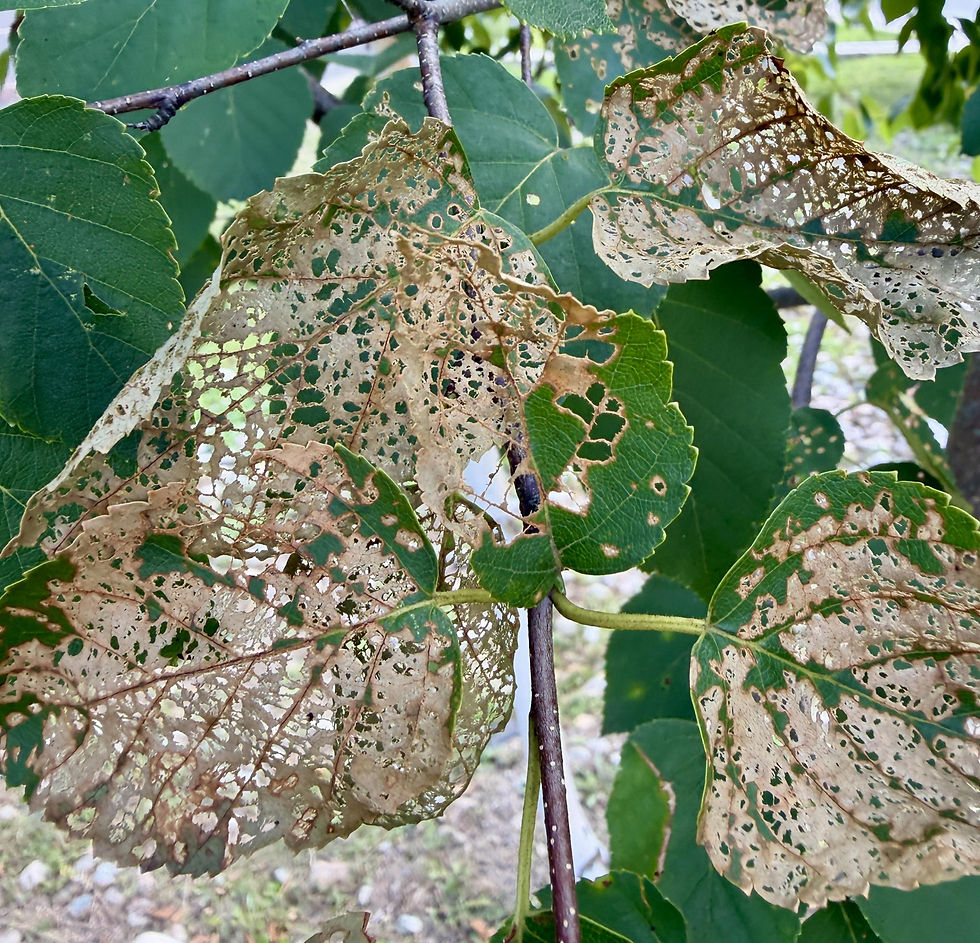
Continue to monitor spider mite activity caused by the spruce spider mite (Oligonychus ununguis) and twospotted spider mite (Tetranychus urticae), among others. It appears that damage from these pests is lower this year, but their populations can increase quickly during dry periods. Japanese beetle (Popillia japonica) damage on littleleaf linden (Tilia cordata), birch (Betula), and Japanese maple (Acer palmatum) has been seen recently.
Rabbit and rodent activity remain high throughout the landscape. Miscellaneous leaf feeding can occur later in the growing season from grasshoppers, katydids, slugs, earwigs, and other various generalists in the garden. It can be challenging to know exactly what is causing the damage in many cases without nighttime scouting.
Nick Brazee, Plant Pathologist,
, reporting from Amherst.


Comments